
María Pagés
Compañía
De Scheherezade
FEATURED SPONSORS
Chevron
The Covington Family Fund
DATE & TIME
Sat. June 20TH, 8:00pm
LOCATION
Journal Theatre, NHCC
About
De Scheherezade
Directed by choreographer Maria Pagés and playwright El Arbi El Harti, De Scheherezade is a vitalist flamenco choreography that explores humanity’s enduring propensity for violence. In eleven scenes, it presents a humanist journey that traces the creative threads of life woven into the feminine essence.
The piece is a powerful narrative built through solos and ensemble choreographies, tightly interlaced by a dramaturgy, choreographic structure, lyrics, and music — meticulously crafted like the Atlas artisans spinning their carpets.
The work’s deeply theatrical conception balances the singularity of each performer with the collective energy of the ensemble. Scheherezade, an archetypal woman who represents all women, travels through choreographic time, reclaiming the spoken word as a tool for redeeming humanity from its cyclical violence.
She reveals to the audience her knowledge and contradictions, her loves and aversions, her strength, vulnerabilities, insecurities, satisfactions, and solitude. She reclaims her humanity — with humility, honesty, and respect. Nothing human is foreign to her.
Scheherezade shares her connection to the body, motherhood, family, land, identity, and the long struggle for equality — with her soul laid bare. She speaks of the light and shadows of contemporary life, invoking both ancient and modern mythologies. Running through the lifeblood of this organic work are the ideas and aspirations of Medea, Zaynab Nefzaouia, Sappho, Hathor, Athena, Saramago’s Blimunda, Lorca’s Bernarda Alba, and Garcia Márquez’s Úrsula.
The choreographies celebrate a collective of women who take center stage to claim both space and voice. Eleven strong individuals embody a plurality of femininity, transcending physical, ethnic, religious, cultural, and aesthetic differences.
“”
Un diamante entre las divas del flamenco. María Pagés se ciñe a la tradición, pero podría encontrar su lugar en los sitios más improbables. (A diamond among flamenco divas. María Pagés sticks to tradition, but she could find her place in the most unlikely places.)
The Washington Post
Paula Durbin
Cast & Credits
María Pagés
Dance, Artistic Direction
Eva Varela
Dance
Marta Gálvez
Dance
Almudena Roca
Dance
Marina González-Madiedo
Dance
Ariana López
Dance
Raquel Guillên
Dance
Alicia Pajuelo de Castro
Dance
Adriana Gómez
Dance
Carla Prado
Dance
María Cebrián
Dance
Ana Ramón Muñoz
Cante
Cristina Pedrosa
Cante
Rubén Levaniegos
Guitar
Isaac Muńoz
Guitar
Gracia del Saz
Violin
Sergio Menem
Cello
Txema Uriarte
Percussion
Olga García
Lights
Kike Cabañas
Sound
Photo: Courtesy the artist
About
María Pagés
María Pagés (Sevilla, 1963) is a flamenco dancer, choreographer, and director whose work has helped position flamenco as a contemporary choreographic language. She began dancing as a child, trained in the orbit of Spain’s Ballet Nacional, and launched her professional career with Antonio Gades’ company before founding María Pagés Compañía in 1990. Her creations tour internationally and combine an exacting flamenco rhythmic foundation with large-scale dramaturgical structures, often integrating text, poetry, and diverse musical sources. Pagés’ honors include Spain’s National Dance Award in the category of Creation, the Gold Medal for Merit in the Fine Arts, and the 2022 Princess of Asturias Award for the Arts (shared with cantaora Carmen Linares).
A central partner in her recent work is El Arbi El Harti (Asilah/Arcila, Morocco), a writer, poet, and dramaturg who has collaborated closely with Pagés since 2011. Formerly a professor of Spanish and Latin American literature at the Universidad Mohamed V (Rabat), he brings a humanist, literary lens to the company’s projects as co-director, dramaturg, and lyricist. Together, Pagés and El Harti also lead the Centro Coreográfico María Pagés in Fuenlabrada, a platform for creation, training, and exchange in dance and flamenco. Their collaboration foregrounds dialogue—between cultures, disciplines, and generations—as both method and artistic ethic.
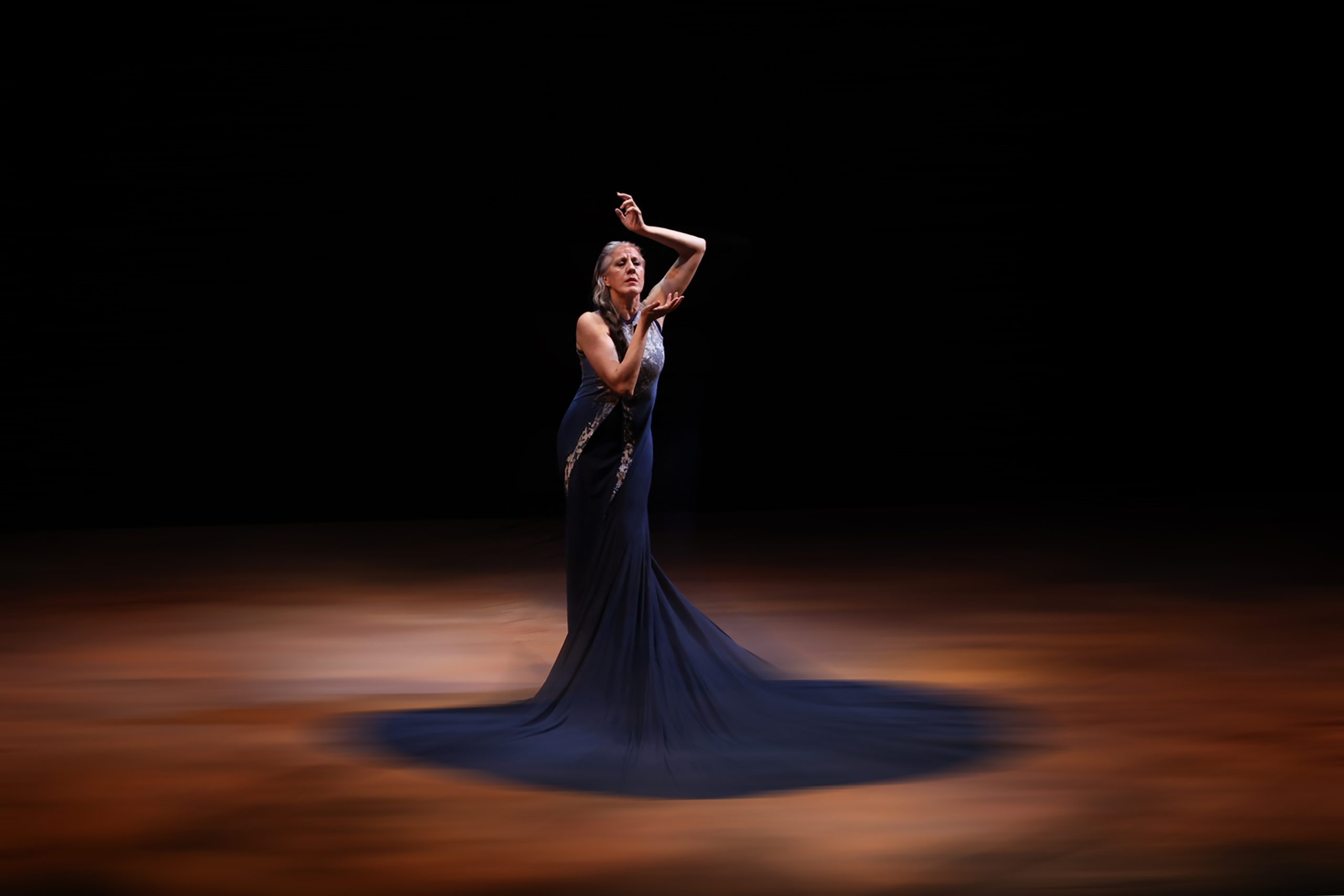
Photo: Courtesy the artist
Study with
María Pagés
during festival flamenco 39
