
María Pagés
Empresa
De Scheherezade
FEATURED SPONSORS
Chevron
The Covington Family Fund
FECHA Y HORA
Sábado,20 de junio, a las 20:00 h
UBICACIÓN
Revista Theatre, NHCC
Acerca de
De Scheherezade
Directed by choreographer Maria Pagés and playwright El Arbi El Harti, De Scheherezade is a vitalist flamenco choreography that explores humanity’s enduring propensity for violence. In eleven scenes, it presents a humanist journey that traces the creative threads of life woven into the feminine essence.
The piece is a powerful narrative built through solos and ensemble choreographies, tightly interlaced by a dramaturgy, choreographic structure, lyrics, and music — meticulously crafted like the Atlas artisans spinning their carpets.
The work’s deeply theatrical conception balances the singularity of each performer with the collective energy of the ensemble. Scheherezade, an archetypal woman who represents all women, travels through choreographic time, reclaiming the spoken word as a tool for redeeming humanity from its cyclical violence.
She reveals to the audience her knowledge and contradictions, her loves and aversions, her strength, vulnerabilities, insecurities, satisfactions, and solitude. She reclaims her humanity — with humility, honesty, and respect. Nothing human is foreign to her.
Scheherezade shares her connection to the body, motherhood, family, land, identity, and the long struggle for equality — with her soul laid bare. She speaks of the light and shadows of contemporary life, invoking both ancient and modern mythologies. Running through the lifeblood of this organic work are the ideas and aspirations of Medea, Zaynab Nefzaouia, Sappho, Hathor, Athena, Saramago’s Blimunda, Lorca’s Bernarda Alba, and Garcia Márquez’s Úrsula.
The choreographies celebrate a collective of women who take center stage to claim both space and voice. Eleven strong individuals embody a plurality of femininity, transcending physical, ethnic, religious, cultural, and aesthetic differences.
“”
Una joya entre las divas del flamenco. María Pagés se ciñe a la tradición, pero podría encontrar su lugar en los sitios más insospechados.
The Washington Post
Paula Durbin
Reparto y créditos
María Pagés
Danza, Dirección artística
Eva Varela
Danza
Marta Gálvez
Danza
Almudena Roca
Danza
Marina González-Madiedo
Danza
Ariana López
Danza
Raquel Guillén
Danza
Alicia Pajuelo de Castro
Danza
Adriana Gómez
Danza
Carla Prado
Danza
María Cebrián
Danza
Ana Ramón Muñoz
Cante
Cristina Pedrosa
Cante
Rubén Levaniegos
Guitarra
Isaac Muñoz
Guitarra
Gracia del Saz
Violín
Sergio Menem
Violonchelo
Txema Uriarte
Percusión
Olga García
Luces
Kike Cabañas
Sonido
Foto: Cortesía del artista
Acerca de
María Pagés
María Pagés (Sevilla, 1963) es una bailaora de flamenco, coreógrafa y directora cuya obra ha contribuido a posicionar el flamenco como un lenguaje coreográfico contemporáneo. Comenzó a bailar de niña, se formó en el entorno del Ballet Nacional de España e inició su carrera profesional en la compañía de Antonio Gades antes de fundar la María Pagés Compañía en 1990. Sus creaciones realizan giras internacionales y combinan una base rítmica flamenca rigurosa con estructuras dramatúrgicas a gran escala, integrando a menudo texto, poesía y diversas fuentes musicales. Entre los galardones de Pagés se encuentran el Premio Nacional de Danza de España en la categoría de Creación, la Medalla de Oro al Mérito en las Bellas Artes y el Premio Princesa de Asturias de las Artes 2022 (compartido con la cantaora Carmen Linares).
Una figura clave en su obra reciente es El Arbi El Harti (Asilah/Arcila, Marruecos), escritor, poeta y dramaturgo que colabora estrechamente con Pagés desde 2011. Antiguo profesor de literatura española y latinoamericana en la Universidad Mohamed V (Rabat), aporta una perspectiva humanista y literaria a los proyectos de la compañía en su calidad de codirector, dramaturgo y letrista. Juntos, Pagés y El Harti también dirigen el Centro Coreográfico María Pagés en Fuenlabrada, una plataforma para la creación, la formación y el intercambio en el ámbito de la danza y el flamenco. Su colaboración pone de relieve el diálogo —entre culturas, disciplinas y generaciones— como método y como ética artística.
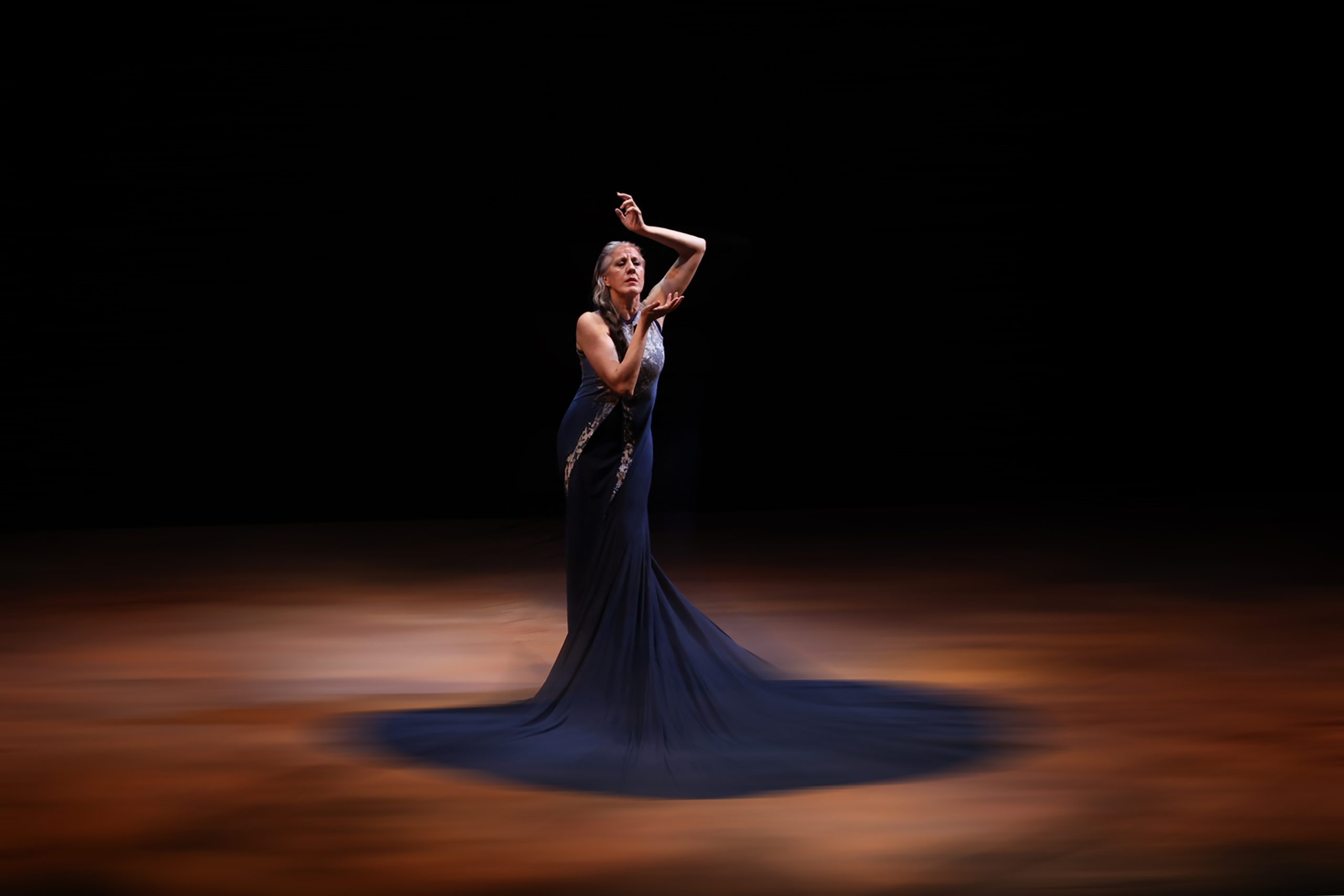
Foto: Cortesía del artista
Estudia con
María Pagés
durante el Festival de Flamenco 39
