María Pagés
Compañía
De Scheherezade
DATE & TIME
Sat. June 20TH, 8:00pm
LOCATION
Journal Theatre, NHCC
About
De Scheherezade
De Scheherezade is a flamenco creation by María Pagés Compañía, devised and directed by María Pagés and El Arbi El Harti. Conceived for a large ensemble, it builds a single protagonist out of many bodies: Scheherezade becomes “one woman, all women,” articulated through solos and densely layered group writing. The dramaturgy proposes twelve choreographic scenes that compress the logic of the thousand-and-one-night tale into a cycle of suspended time: eleven nights of active waiting, with tension resolving at the dawn of the twelfth day. Within this frame, mythic and literary figures—Scheherezade, Carmen, Medea, Wallada, Sappho, Yerma, Blimunda, Úrsula Iguarán—coexist as facets of feminine experience rather than as narrative characters.
Pagés’ choreography works by contraposition: harmony and symmetry are established, broken, and recomposed, so the ensemble continually moves between individual singularity and collective force. El Harti’s text-and-lyric layer insists on the ethical stakes of speech: the word as a tool for demystification and for refusing violence. Music extends the work’s choral logic. Original composition (Rubén Levaniegos, Sergio Menem, David Moñiz, and Pagés) unfolds in dialogue with classical and popular references and an explicit investigation of Moroccan sonorities. Live performance features strings and percussion alongside Arabic vocals and flamenco singing, creating a sonic field where palos and timbres migrate across traditions.
Visually, the staging frames the feminine imaginary with desert and palace imagery—spaces that test knowledge, sensitivity, and desire—supported by Olga García’s lighting and Pagés’ costume design. First created for the Gran Teatre del Liceu (Barcelona) and the Abu Dhabi Music & Arts Foundation, the work continues the company’s inquiry begun with Yo, Carmen (2015): how to choreograph women’s plurality as both lived reality and moral commitment.
Top photo: Courtesy the artist
“”
Un diamante entre las divas del flamenco. María Pagés se ciñe a la tradición, pero podría encontrar su lugar en los sitios más improbables. (A diamond among flamenco divas. María Pagés sticks to tradition, but she could find her place in the most unlikely places.)
The Washington Post
Paula Durbin
Cast & Credits
María Pagés
Dance, Artistic Direction
Eva Varela
Dance
Marta Gálvez
Dance
Almudena Roca
Dance
Marina González-Madiedo
Dance
Ariana López
Dance
Raquel Guillên
Dance
Alicia Pajuelo de Castro
Dance
Adriana Gómez
Dance
Carla Prado
Dance
María Cebrián
Dance
Ana Ramón Muñoz
Cante
Cristina Pedrosa
Cante
Rubén Levaniegos
Guitar
Isaac Muńoz
Guitar
Gracia del Saz
Violin
Sergio Menem
Cello
Txema Uriarte
Percussion
Olga García
Lights
Kike Cabañas
Sound
Photo: Courtesy the artist
About
María Pagés
María Pagés (Sevilla, 1963) is a flamenco dancer, choreographer, and director whose work has helped position flamenco as a contemporary choreographic language. She began dancing as a child, trained in the orbit of Spain’s Ballet Nacional, and launched her professional career with Antonio Gades’ company before founding María Pagés Compañía in 1990. Her creations tour internationally and combine an exacting flamenco rhythmic foundation with large-scale dramaturgical structures, often integrating text, poetry, and diverse musical sources. Pagés’ honors include Spain’s National Dance Award in the category of Creation, the Gold Medal for Merit in the Fine Arts, and the 2022 Princess of Asturias Award for the Arts (shared with cantaora Carmen Linares).
A central partner in her recent work is El Arbi El Harti (Asilah/Arcila, Morocco), a writer, poet, and dramaturg who has collaborated closely with Pagés since 2011. Formerly a professor of Spanish and Latin American literature at the Universidad Mohamed V (Rabat), he brings a humanist, literary lens to the company’s projects as co-director, dramaturg, and lyricist. Together, Pagés and El Harti also lead the Centro Coreográfico María Pagés in Fuenlabrada, a platform for creation, training, and exchange in dance and flamenco. Their collaboration foregrounds dialogue—between cultures, disciplines, and generations—as both method and artistic ethic.
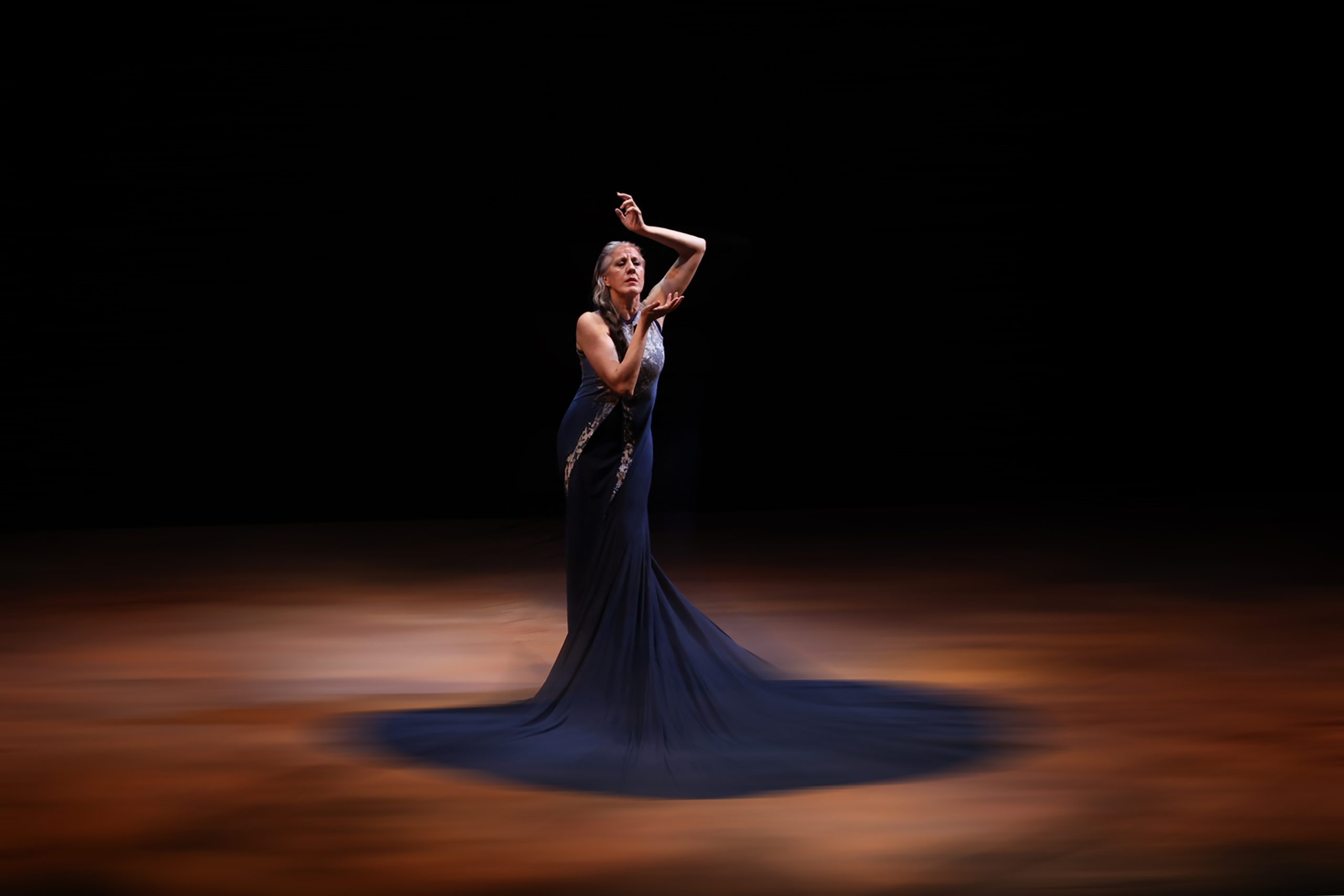
Photo: Courtesy the artist
Study with
María Pagés
during festival flamenco 39
